Bitcoin is falling with chip stocks. What the liquidations hint at
SanDisk, SOXL and Intel made the top ten liquidations on crypto exchanges on Nov 2. How the Nasdaq correction is dragging bitcoin down.

Also in: Русский
Contents
On November 2, four of the ten most liquidated tickers on crypto exchanges weren't crypto. SanDisk (SNDK) lost $14.1 million in forced closes, the 3x chip ETF SOXL $12 million, crude oil (CL) $6.4 million and Intel (INTC) $4.3 million. Between 93% and 99% of it was longs, according to MarginPad. SanDisk saw more liquidations than Zcash or HYPE.
I think that table says a lot about why bitcoin slid under $77,000 today.
What happened on Wall Street
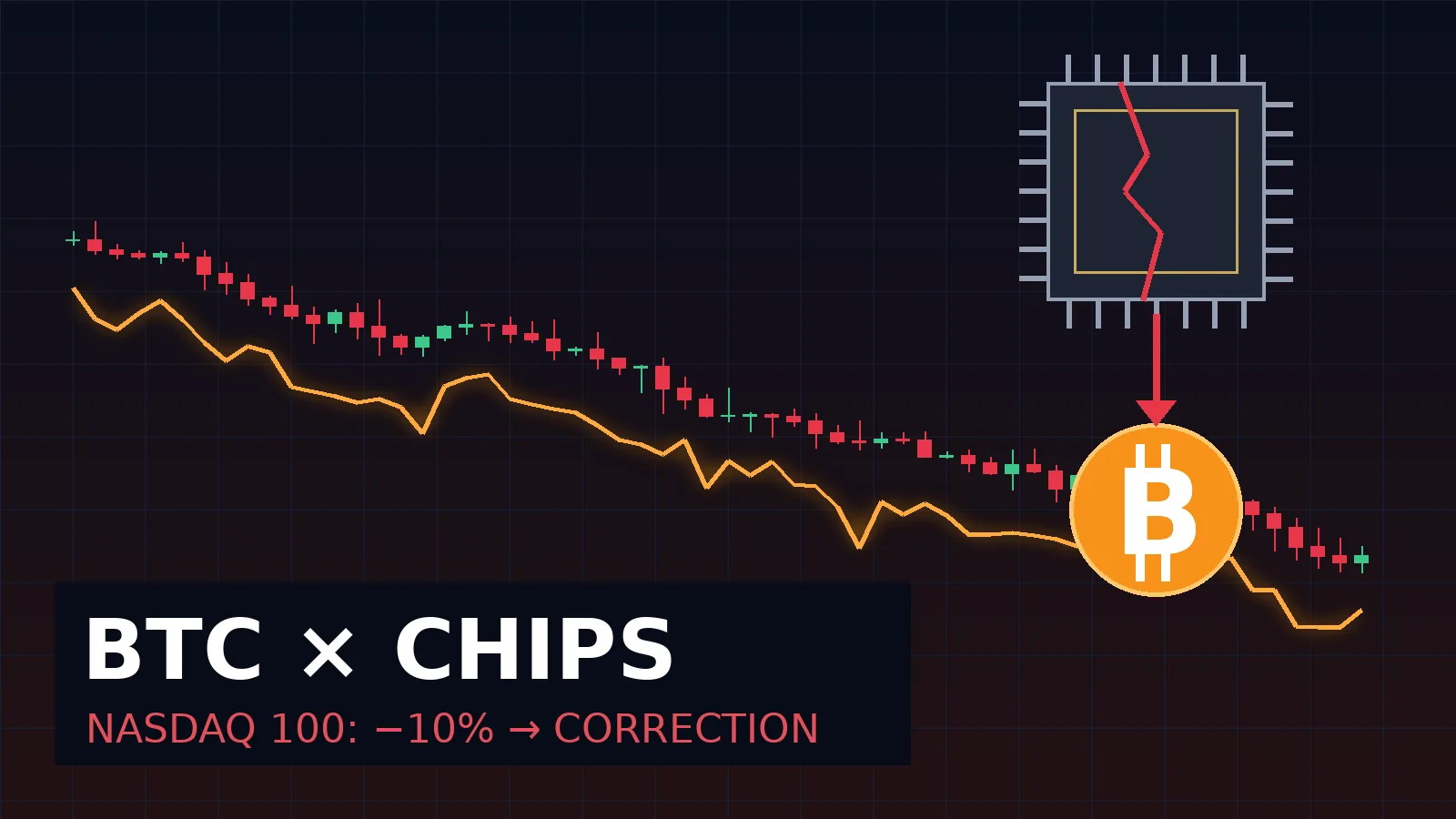
It started on Friday, October 30. Intel issued a disappointing fourth-quarter revenue forecast and the stock fell 28.6% in a day. AMD dropped 10.9%, Marvell and Arm about 10% each. The Philadelphia Semiconductor Index (SOX) lost 7.2% and the Nasdaq 100 fell 3.46% (Velocity Financial Brokers, Aju Press).
Monday kept going. The Nasdaq 100 closed at 27,989.82, more than 10% below its October 6 record. A 10% drop from a peak is what the market calls a correction, and this is the third one this year. SOX fell another 3.37%, Marvell 12.7%, and Oracle 8.9% after laying out plans to raise $20 billion (Political.org). The market is no longer sure all that AI data-center spending will pay for itself.
By Tuesday morning in Asia, Korea's Kospi was down more than 3%. Bitcoin lost about 2%, slipped just under $77,000 and gave back Monday's whole bounce. Zcash fell almost 10%, BNB went below $700, and ether held just above $2,250 (CoinDesk).
Why crypto follows chips
The usual line is that risk assets fall together. True enough, but it skips the plumbing. What follows is my read of the plumbing; the sources don't spell it out.
The venues where people lever up on bitcoin now let them lever up on stocks, ETFs and oil too. It's easy to picture one trader holding a SOXL long next to a BTC long. Chips drop, margin shrinks. Then either the trader cuts something to save the account, or the exchange does it for them. What gets sold can be whatever is liquid right now, and that means bitcoin.
The November 2 numbers fit that picture. $310.8 million was liquidated, 78% of it longs. The worst hour was 17:00–18:00 UTC with $82.3 million, the middle of the New York session on the day the Nasdaq closed in correction. The median liquidation was $303, so by count it was mostly leveraged retail, though the single largest was an $8.3 million ETH long on Binance.
MarginPad only counts forced closes on perpetual futures. It can't see what people sold by hand.
The bull case
There is another way to read the week. Shorts on CME add up to about 29,220 BTC, roughly $2.2 billion. After the Binance hack a lot of coins left exchanges for cold storage. Chris Sullivan of Hyperion Decimus calls that "very bullish but not immediately" (CoinDesk). If price turns up, shorts have to buy back while fewer coins sit on exchanges.
I wouldn't lean on that yet. Part of the CME short book usually hedges ETF longs in a basis trade, and a rally won't force those positions out. CoinDesk also notes the hack has muddied positioning data. Updated futures figures are due today. For now the nearest guide for bitcoin is the Nasdaq.
What it means if you trade
If crypto and stocks share one cross-margin account, treat them as one bet. A bad Intel print can close your bitcoin long before bitcoin itself gets anywhere near your level.
The week is crowded. AMD reports today, US election results start landing overnight, and payrolls come out Friday (Velocity Financial Brokers). While the Nasdaq is in correction, I'm checking the SOX chart about as often as the bitcoin chart.
Daily market data on X: @tarvis_trade