French Bank Loses $133M in Crypto Exploit. Four Hours — and Stablecoins Became Ether
French bank Crédit Mutuel Arkéa lost $133M — funds withdrawn from exchanges, converted to ETH and XMR within 4 hours. Tether froze part of USDT, but Ether cannot be frozen. What this means for traders keeping money on exchanges.

Also in: Русский
Contents
French Bank Loses $133M in Crypto Exploit. Four Hours — and Stablecoins Became Ether
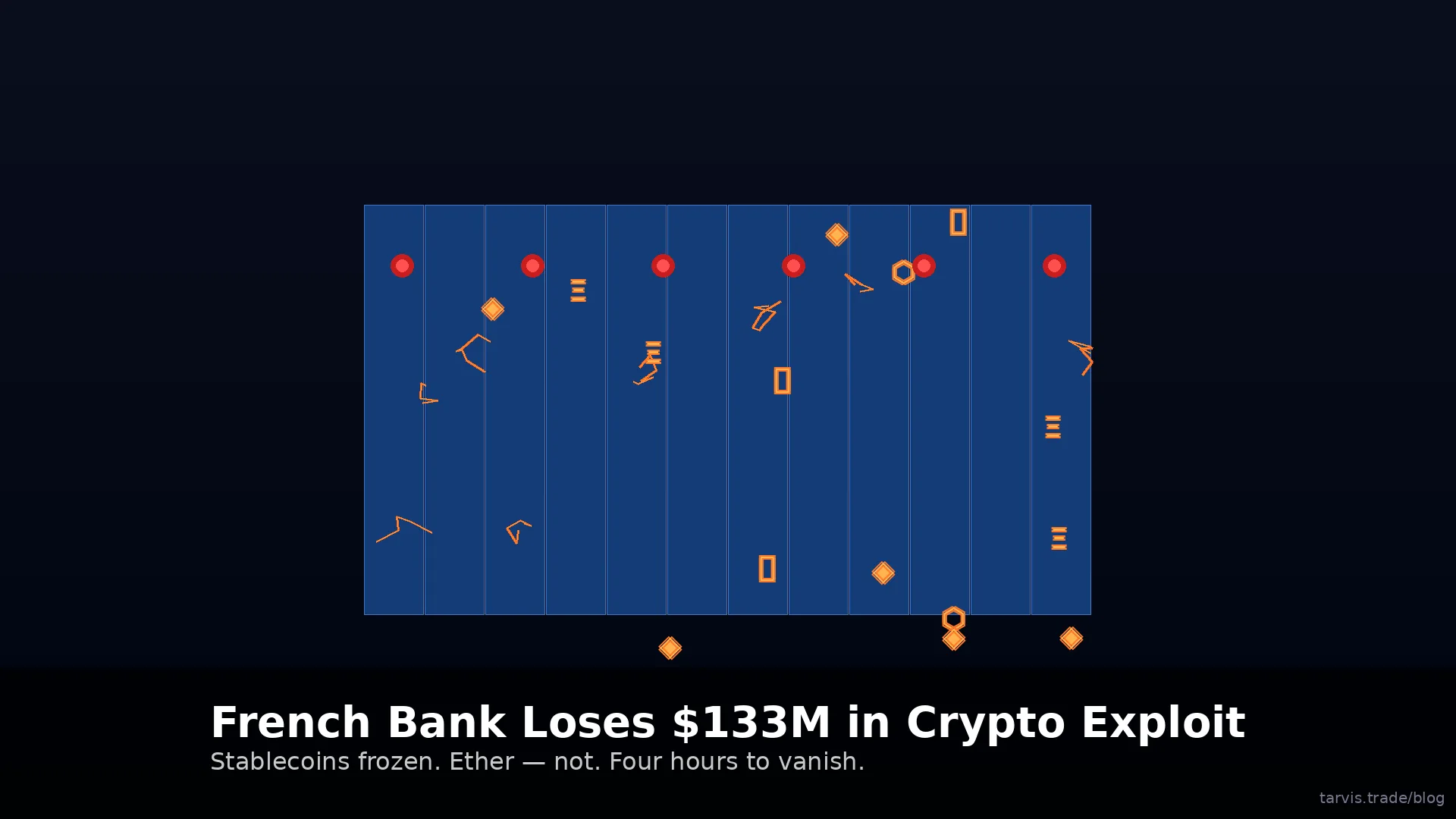
On-chain investigator ZachXBT identified French bank Crédit Mutuel Arkéa as the alleged victim of a theft exceeding $133M, withdrawn from centralized exchange accounts. The initial alert on November 2 cited $106M+; a day later ZachXBT added another $27M+ in suspicious withdrawals. Funds moved in USDC and USDT, then within four hours were swapped into ETH and XMR across multiple chains. The bank has not publicly confirmed or denied the incident.
Stablecoins Can Be Frozen. Ether Cannot
Per Bitquery, $62.98M in stablecoins were swapped into ETH in roughly four hours. By the November 3 snapshot, Tether had frozen 1.14M USDT tied to the incident. But the ETH sitting at the same addresses could not be frozen — Ether has no issuer with a freeze function. Kraken and Crypto.com restricted the accounts that received the funds and are cooperating with law enforcement. Yet a portion of the money is already on-chain, where clawback is impossible.
What This Means for a Trader Keeping Funds on an Exchange
Your exchange balance is not your coins. It is a claim against the exchange. When a legal request arrives or analysts like ZachXBT flag addresses, the exchange restricts withdrawals in minutes. Your funds can end up in a "frozen" pool simply because "dirty" tokens passed through the same deposit address.
Speed matters: four hours from withdrawal to ETH swap. In that window Tether managed to freeze part of the USDT. But once funds move into a chain's native asset (ETH, BTC, XMR) — issuer control ends. The takeaway for traders: if you want to control your assets, hold them in a self-custody wallet. On an exchange, they are someone else's risk.
A Binance-Scale Lesson at a Smaller Scale
Binance lost $6.34B. Here it is $133M. The mechanics are identical: phishing/social engineering → API/account access → exchange withdrawals → rapid swap into non-freezable assets. The difference is scale, not method. Traders who did not move core capital to cold storage after Binance just got a repeat lesson.
Daily market data on X: @tarvis_trade