U.S. Cuts MEXC Off the Financial System: What Traders Need to Know
FinCEN severed MEXC Global (top-20 exchange) from U.S. banking over $16B in illicit flows tied to Iran, North Korea, Russia. Traders have ~30 days to exit. Precedent for every offshore venue.

Also in: Русский
U.S. Cuts MEXC Off the Financial System: What Traders Need to Know
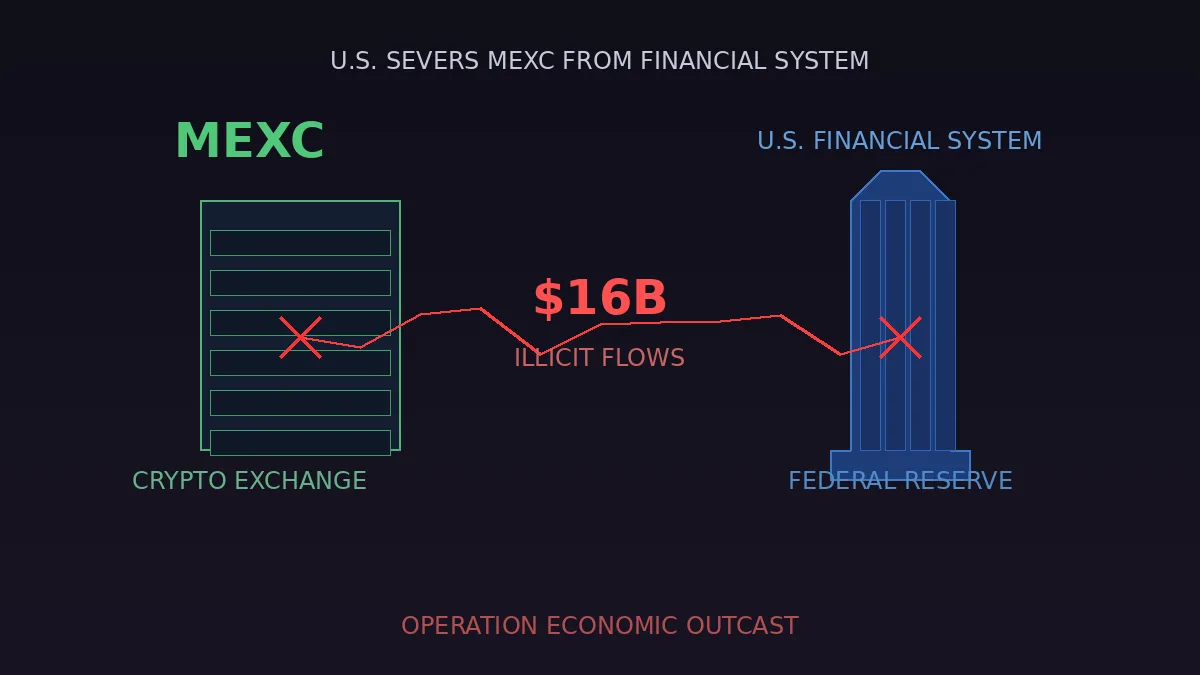
FinCEN dropped a final order Friday: MEXC Global — a top-20 global crypto exchange — is severed from the U.S. banking system. The charge: at least $16 billion in illicit transactions tied to Iranian, North Korean, and Russian sanctions evasion, plus cybercrime. The order takes effect 30 days after Federal Register publication.
This isn't a warning shot. It's the nuclear option: U.S. banks, money transmitters, and other covered institutions cannot process any transfers — fiat or crypto — to or from MEXC wallets and accounts. Willful violations carry civil and criminal penalties.
How we got here
Between May 2021 and May 2026, MEXC moved a minimum of $16 billion in dirty flows. Treasury's press release breaks it down:
- ~$1.5 billion — Russian sanctions evasion, including $232 million in direct transactions with U.S./EU/UK-sanctioned entities.
- ~$26 million — to the Russia-based A7 sanctions-evasion network.
- ~$200 million — via the A7A5 stablecoin.
- ~$22 million — directly benefiting Iran's Central Bank and the IRGC-Qods Force, both OFAC-sanctioned.
- ~$1 billion — direct transactions with 40+ Iranian VASP counterparts, some sanctioned.
- North Korean flows (Lazarus Group) — amounts undisclosed but explicitly cited.
MEXC publicly claimed AML controls and banned users from Iran and the DPRK. In practice — "severe deficiencies." The exchange was still processing withdrawals from Garantex (sanctioned April 2022) and its successor Grinex as recently as June 2026 — four years post-designation.
Why this matters for every trader
Liquidity and exit access. MEXC does >$1 billion daily volume, holds ~$5 billion in reserves, lists 3,000+ tokens. If you have funds there, you have ~30 days (from Federal Register publication) to withdraw before the order bites. After that, fiat rails close. Crypto withdrawals aren't explicitly banned, but without a fiat on-ramp the exchange loses fresh capital and market makers exit.
Precedent for offshore exchanges. FinCEN used Section 9714(a) of the Combating Russian Money Laundering Act — a tool built for Russian laundering, now applied to a global exchange. Signal: any major offshore player that "accidentally" passes sanctioned flows can get the same treatment. Next candidates: exchanges with heavy Russian, Iranian, or DPRK volume and opaque KYC/AML.
Stablecoins in the crosshairs. The A7A5 callout ($200M) and mass USDT/USDC flows through sanctioned addresses hint at Treasury's next lever: pressure stablecoin issuers to freeze faster. Tether and Circle already reacted to the Binance hack (froze $1.57B and $800M respectively). Expect acceleration.
Not OFAC, but FinCEN — a crucial distinction. This isn't an SDN designation. It's a funds transmittal order under 9714(a). No lengthy rulemaking, faster effective date, harder to challenge in court. Treasury deliberately chose the speed tool.
What to do right now
- If you have funds on MEXC — withdraw. Priority: BTC, ETH, major stablecoins. Low-liquidity alts risk getting stuck.
- Vet your counterparty. Any exchange without a clear jurisdictional anchor and transparent AML is in the danger zone.
- Watch the Federal Register. The order goes live exactly 30 days after publication. That's your exit window.
- Diversify fiat rails. Don't concentrate all off-ramps in one jurisdiction.
The bigger picture
Operation Economic Outcast isn't about MEXC. It's about the end of "declare AML, launder $16B for sanctioned regimes." Binance just weathered a $6.3B hack (Lazarus, same North Korea). Treasury is connecting dots: same actors, same methods, same offshore hubs.
For traders the takeaway is simple: the "exchange anywhere, money anywhere" era is ending. Regulators are learning to move faster than markets. Adapt or watch your funds freeze on a severed platform.
Daily market data on X: @tarvis_trade